ICMR opens its labs to 30000 school students through S.H.I.N.E. 2026
ICMR’s S.H.I.N.E. 2026 will bring nearly 30,000 students from Grades 9–12 face-to-face with scientists at 83 locations, offering them a glimpse into research and public health innovation.
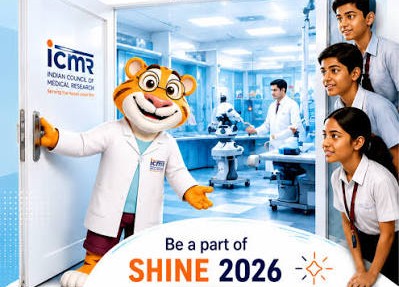
The nationwide initiative will be conducted at 83 locations, including ICMR institutes, DHR-Model Rural Health Research Units and affiliated field units.

NEW DELHI: What happens when school students are allowed to walk into a research laboratory and spend a day seeing science in action?
The Indian Council of Medical Research is taking that question to 30,000 students across India.
The Department of Health Research-Indian Council of Medical Research (DHR-ICMR) will organise the second edition of S.H.I.N.E. — Science, Health and Innovation for NextGen Explorers — on August 11 and 12, bringing students from Grades 9 to 12 into direct contact with scientists and research institutions.
The nationwide initiative will be conducted at 83 locations, including ICMR institutes, DHR-Model Rural Health Research Units and affiliated field units.
The programme has been inspired by Prime Minister Narendra Modi’s call for students to “spend one day as a scientist”, turning what is often an abstract idea in a classroom into a first-hand experience of how scientific research actually works.
For students, the experience is designed to go beyond listening to lectures about science.
They will be taken through research laboratories, scientific exhibitions and poster walks, while video presentations and live demonstrations will offer them a closer look at ongoing scientific work.
More importantly, students will get an opportunity to interact directly with ICMR scientists and learn about their research journeys, areas of expertise and the everyday work involved in addressing public-health challenges.
The second edition marks a significant expansion of the initiative. While S.H.I.N.E. was launched as a school outreach programme, the 2026 edition is being taken across the country with participation expected from around 30,000 students.
Unlike an open application-based programme, participation this year is by invitation. ICMR laboratories are inviting nearby government and private schools to bring students into the initiative.
The focus is on students in Grades 9 to 12 — a stage at which many begin making choices about higher education and careers. By bringing them into research institutions before those decisions are made, the programme seeks to give them a more realistic understanding of what a career in science can look like.
The emphasis is also deliberately placed on health and public health.
Students will be exposed to research that addresses real-world health challenges, allowing them to see how scientific enquiry connects with the problems faced by communities around them.
That could be an important distinction from conventional science outreach, where scientific concepts are often presented as classroom knowledge rather than as tools for solving problems.
S.H.I.N.E. seeks to bridge that gap by putting students in the environment where research happens.
The programme also takes science beyond India’s major research centres. The inclusion of DHR-Model Rural Health Research Units and affiliated field units gives students an opportunity to see how health research operates closer to communities and how scientific evidence can be applied to local public-health challenges.
Dr. Rajiv Bahl, Secretary, Department of Health Research and Director General, ICMR, has welcomed the participating students and encouraged them to make the most of their interaction with scientists and their exposure to research laboratories.
The initiative is aligned with the government’s Viksit Bharat 2047 vision and is intended to strengthen scientific curiosity among young learners, particularly in areas connected with public health and innovation.
For ICMR, the objective goes beyond conducting a two-day outreach programme.
By opening the doors of its institutes and research units to school students, the organisation is attempting to make scientific research more tangible and accessible to the next generation.
A laboratory visit can show students something that a textbook cannot — that science is not merely a collection of theories, equations and examination questions, but a process of asking questions, testing ideas and developing solutions to problems that affect people’s lives.
That is particularly relevant in public health, where India’s future challenges will require researchers capable of combining scientific knowledge with an understanding of the country’s diverse health needs.
S.H.I.N.E. 2026 therefore places young students on the other side of the laboratory door — not as spectators of science, but as potential future participants in it.
For a country looking to build its scientific and technological capabilities over the next two decades, that exposure could prove as important as the research happening inside the laboratories themselves.