Parliamentary panel pushes India towards predictive, technology-driven security and disaster governance
Parliamentary panel proposes AI-driven cybercrime and disaster systems, nationwide e-FIRs, integrated data platforms and a shift from disaster relief to predictive resilience.
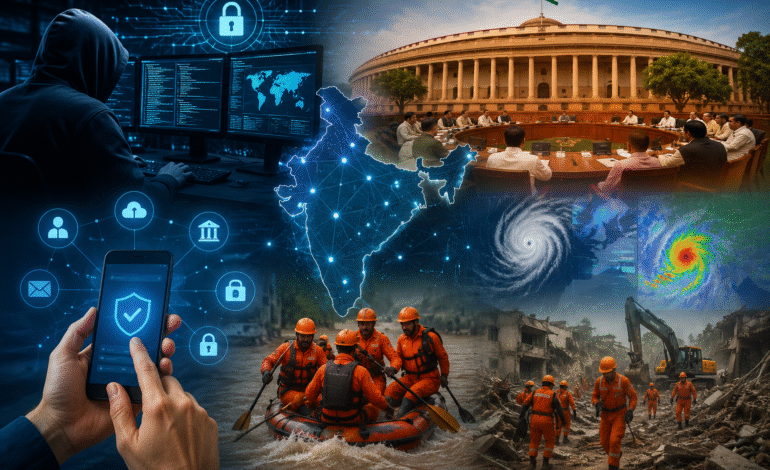
As more public services, financial transactions and critical infrastructure move onto digital platforms, the ability to detect threats early and coordinate responses across government and industry is becoming a critical component of India's digital infrastructure.

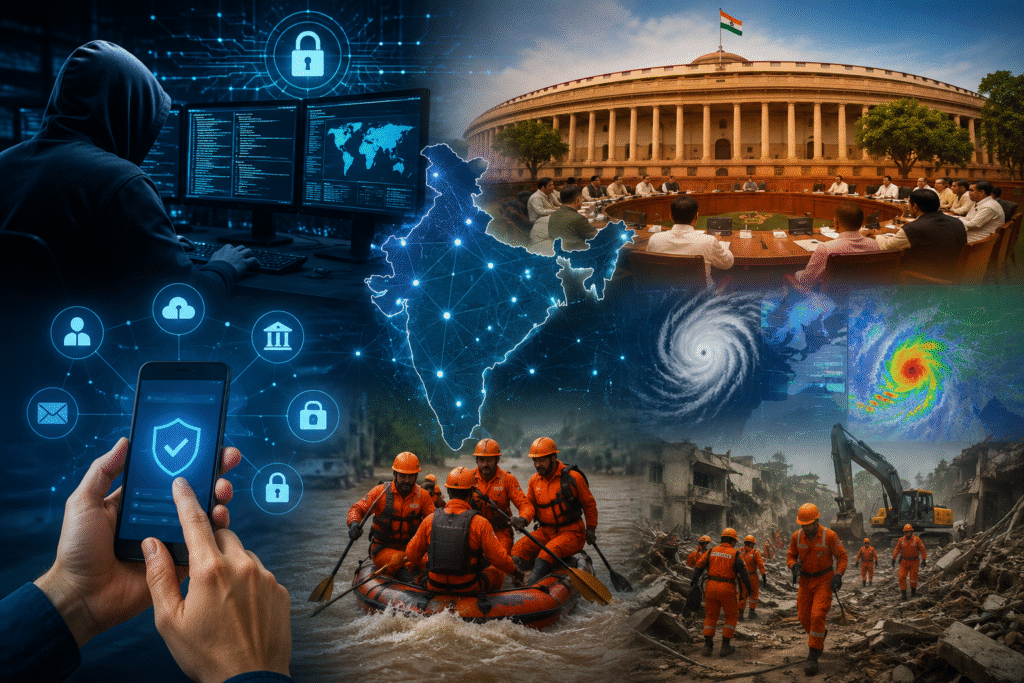
NEW DELHI: India’s internal security and disaster-management architecture may need a fundamental shift – from fragmented, reactive responses to integrated, technology-driven and predictive systems – according to a series of recommendations made by the department-related Parliamentary Standing Committee on Home Affairs in three reports presented to Parliament.
The Committee, chaired by Dr Radha Mohan Das Agrawal, presented its 259th, 260th and 261st Reports on August 7, covering cybercrime, the development and internal security of Jammu & Kashmir and border preparedness in Ladakh, and disaster management, respectively.
Taken together, the three reports point towards a broader transformation in India’s governance of emerging risks. The recommendations seek to connect digital identity and grievance systems, cybercrime investigation, financial-fraud intelligence, artificial intelligence, geospatial technologies, early-warning systems, disaster response forces and real-time data platforms into more coordinated national and local response mechanisms.
From cybercrime reporting to an integrated digital security architecture
The Committee’s recommendations on cybercrime go considerably beyond strengthening existing enforcement mechanisms. They call for a more standardised digital architecture in which citizens can report offences, track complaints and receive timely decisions, while investigators and financial institutions can share intelligence more effectively.
On grievance redressal by digital intermediaries, the Committee has recommended a standardised, accessible and multilingual system with unique complaint numbers, tracking facilities, defined disposal timelines, reasoned decisions and automatic escalation of unresolved complaints. It has also called for periodic publication of anonymised grievance statistics and harmonisation of grievance mechanisms with the emerging data-protection framework.
The recommendations extend to the rapidly expanding digital-content ecosystem. The committee has called for examination of an independent post-release review panel for flagged OTT content, comprising experts in areas including child development, education, law, social sciences and civil society. It has also suggested technology-enabled age verification, parental controls and penalties for non-compliance.
The committee has also identified offshore digital advertising as a potential vulnerability. It has recommended digital-document verification, live identity authentication and continuous monitoring based on zero-trust principles for offshore advertisers to reduce fraudulent and deceptive advertising aimed at Indian users.
One of the more significant recommendations is the creation of a comprehensive, real-time and interoperable Central Payment Fraud Information Registry. The Committee wants the registry to enable banks and other stakeholders to share fraud intelligence, analyse threats across the financial system and identify emerging patterns early. It has also welcomed the expansion of MuleHunter.ai to additional banks while calling for the payment-fraud registry to be fully operationalised.
A nationwide e-FIR architecture for cybercrime
The committee has also pushed for a more seamless transition from cybercrime complaints to formal investigation.
It has recommended that the Ministry of Home Affairs, through the Indian Cyber Crime Coordination Centre (I4C), formulate a time-bound roadmap for nationwide implementation of e-FIRs, including automatic conversion of complaints received through the National Cyber Crime Reporting Portal into e-FIRs.
The objective is not merely procedural digitisation. The committee sees such integration as a means of accelerating investigation and improving the chances of recovery and refund of money defrauded from victims.
The panel has simultaneously called for a mandatory, age-appropriate cyber-safety curriculum across school boards, supported by teacher training, multilingual learning material and practical education on reporting cybercrime and online abuse.
At the legal level, it has recommended a periodic multidisciplinary mechanism involving the Home Ministry, MeitY, the Ministry of Law and Justice and relevant regulators to keep the cybercrime framework aligned with emerging technologies and evolving threats.
More significantly, the Committee has reiterated the need for comprehensive and unified cybercrime legislation with technology-neutral provisions and effective penalties for emerging offences. It has also recommended a specialised Integrated Cybercrime Task Force with nationwide jurisdiction, technical expertise and inter-agency coordination to deal with complex and transnational cybercrime.
Jammu & Kashmir: development, connectivity and security increasingly converge
The 260th Report takes a wider view of Jammu & Kashmir and Ladakh, treating infrastructure, economic development, social welfare and security as interconnected elements of regional resilience.
The committee has recognised technology-enabled disaster and crowd-management systems at the Shri Mata Vaishno Devi Shrine, including RFID-based pilgrim tracking, AI-based surveillance and an integrated command and control centre. It has recommended periodic upgrading of the system with stronger predictive risk assessment, early-warning capabilities, emergency medical infrastructure, evacuation systems and multi-agency mock drills.
The report also places significant emphasis on resilient connectivity. It supports continued strengthening of railway infrastructure and recommends geotechnical monitoring, structural-health monitoring, predictive maintenance and climate-resilient engineering because of the region’s geological and seismic characteristics.
A similar approach has been proposed for roads, with climate-resilient specifications, strategic tunnels, urban decongestion measures and disaster preparedness integrated into infrastructure planning.
The committee has also backed the proposed ₹1,667-crore Civil Enclave at Srinagar and suggested examining the feasibility of an airport or alternative aviation facility in the Katra region to improve access for pilgrims and tourists.
Beyond physical infrastructure, the report links sustainable development with energy security, agriculture, healthcare, education, industrialisation and employment. It recommends greater use of digital platforms and institutional finance, stronger healthcare and telemedicine infrastructure, improved school retention, and closer alignment of vocational education with sectors such as tourism, horticulture, agriculture, handicrafts, healthcare, IT and renewable energy.
The committee also highlights the need to strengthen security at tourist and religious destinations through integrated surveillance, centralised monitoring, vulnerability assessments and inter-agency standard operating procedures. For the Amarnath Yatra and other high-footfall areas, it recommends unified command-and-control arrangements and real-time information sharing.
At the strategic level, the report calls for continued investment in integrated intelligence, surveillance and reconnaissance capabilities, counter-drone systems, secure communications and indigenous high-altitude technologies. It also recommends stronger logistics infrastructure, including all-weather roads, tunnels, bridges, storage facilities and alternative supply routes for forward areas.
Disaster management needs a new operating model
The 261st Report arguably provides the broadest indication of the Committee’s vision for the future of India’s resilience architecture.
It recommends a formal review of the National Policy on Disaster Management, 2009, arguing that the country’s risk landscape has changed substantially because of climate change, rapid urbanisation and technological advances.
The committee specifically wants the revised framework to incorporate AI and geospatial technologies for weather forecasting, cyclone tracking, damage assessment and early-warning dissemination. It has also called for an expedited revision of the National Disaster Management Plan in light of the Disaster Management (Amendment) Act, 2025, the National Disaster Mitigation Fund and advances in AI-assisted forecasting.
This represents an important conceptual shift: disaster management is increasingly being viewed not simply as a response mechanism after an event but as a data-driven risk-management system capable of anticipating hazards and reducing exposure before disasters strike.
The committee has recommended standardised disaster-management plans and benchmarking across states and districts, with plans updated at least once every two years. It has also called for at least two multi-agency drills annually at state and district levels, followed by structured evaluations and time-bound corrective action.
AI, hazard mapping and hyper-local warnings
The committee has called for multi-hazard risk mapping covering floods, landslides, seismic risks and glacial-lake hazards, with such mapping to become enforceable in planning and development.
It has further recommended that seismic microzonation and landslide-susceptibility maps be integrated into town-planning regulations and building bylaws, supported by a national repository of hazard, vulnerability and risk data.
Major infrastructure and urban-development projects, it says, should undergo mandatory disaster risk impact assessment before approval.
The technology agenda is equally explicit. The committee wants greater investment in AI and machine-learning predictive models, Doppler weather radars, high-resolution numerical weather prediction and satellite-based monitoring.
It has also proposed a national, interoperable multi-hazard early-warning system linking agencies including the India Meteorological Department, Central Water Commission, INCOIS, NRSC and state authorities.
But perhaps more significant is its call to move beyond district-level alerts towards hyper-local warnings reaching villages, urban wards and vulnerable habitations.
That approach could fundamentally change how citizens experience India’s early-warning systems: from generic regional warnings to location-specific, actionable information.
From relief to resilience
The committee has also questioned the traditional relief-centric orientation of disaster spending.
It has recommended a gradual but definitive shift towards mitigation-focused investment, with greater budgetary priority for risk reduction, resilience-building and preventive infrastructure. It has also proposed stronger monitoring of mitigation funds and wider insurance coverage for households, agriculture and MSMEs to improve financial resilience.
The report addresses specific hazards ranging from cyclones and floods to earthquakes, tsunamis, landslides, heatwaves and chemical disasters.
For urban India, it recommends making urban flood management a core responsibility of urban local bodies, with city-level flood plans, drainage master plans and emergency-response protocols. Restoration of wetlands, lakes and natural drainage channels is also proposed as part of flood-risk reduction.
For earthquakes, the committee calls for stricter enforcement of building codes, seismic hazard mapping, resilient urban planning and a time-bound programme to retrofit critical infrastructure such as schools, hospitals, power plants, water systems and emergency centres.
It has also recommended stronger heat-action plans, heat-resilient urban planning, greater green cover, cool roofs, shaded public spaces, water access and improved health-system preparedness in heat-prone regions.
Strengthening the first-response layer
The Committee has identified a structural weakness in the country’s disaster-response architecture: the limited capacity of the National Disaster Response Force (NDRF) to handle multiple simultaneous disasters and the absence of State Disaster Response Forces in all States and Union Territories.
It has recommended augmentation of NDRF strength and specialised capabilities, while mandating the establishment and operationalisation of SDRFs across States and UTs with Central financial and technical support.
It also wants stronger interoperability between NDRF and SDRF through joint training, mock drills, common SOPs and communication platforms.
The recommendations extend into the digital backbone of emergency response. Existing platforms such as the Integrated Control Room for Emergency Response and Emergency Response Support System (Dial 112) should, according to the committee, be integrated with real-time data from central and state agencies, supported by advanced analytics and visualisation tools.
The India Disaster Resource Network should likewise be upgraded with real-time resource information and connected to police emergency systems, fire departments, hospitals and ambulance services.
A common thread across three reports
The significance of the three reports lies not merely in the number of recommendations but in the common architecture emerging from them.
Cybercrime, financial fraud, border security, infrastructure, tourism, public health and natural disasters are increasingly difficult to manage within traditional administrative silos. The Committee’s recommendations point towards a model built around real-time data, interoperable platforms, artificial intelligence, predictive analytics, specialised response capabilities and stronger coordination between institutions.
In cybercrime, that means moving from complaint registration to integrated investigation and financial intelligence. In disaster management, it means moving from relief after an event to risk prediction and mitigation before it. In Jammu & Kashmir and Ladakh, it means treating infrastructure, development, connectivity and security as mutually reinforcing components of resilience.
The reports therefore offer a larger governance message: India’s next-generation internal security and resilience architecture will depend as much on the country’s ability to connect data, technology and institutions as on the strength of individual agencies.
The three reports were adopted by the committee at its meeting on August 5 and presented to Parliament on August 7.