BIS hallmarking crosses 65-crore gold articles as HUID system strengthens jewellery traceability
With over 2.36 lakh registered jewellers and 1,565 recognised hallmarking centres, BIS is expanding digital verification and regulatory surveillance to improve consumer confidence in gold and silver jewellery purchases.
The Bureau of Indian Standards (BIS), which oversees the hallmarking system, has also expanded its network of registered jewellers and recognised Assaying and Hallmarking Centres (AHCs), while strengthening digital traceability and regulatory surveillance.

NEW DELHI: More than 65 crore gold jewellery articles have received Hallmark Unique Identification (HUID) numbers since mandatory gold hallmarking was introduced in 2021, reflecting the expansion of India’s quality assurance and consumer protection framework for precious metal jewellery.
The Bureau of Indian Standards (BIS), which oversees the hallmarking system, has also expanded its network of registered jewellers and recognised Assaying and Hallmarking Centres (AHCs), while strengthening digital traceability and regulatory surveillance.
According to a PIB backgrounder dated November 5, 2026, the number of BIS-registered operative jewellers increased from 43,153 in 2021 to 2,36,624 as of October 15, 2026. The number of recognised AHCs rose from 948 to 1,565 during the same period.
For silver, although hallmarking remains voluntary, HUID-based identification became mandatory for all silver articles submitted for hallmarking from September 1, 2025. More than 90 lakh silver articles have received HUID-based hallmarks.
Mandatory hallmarking expands consumer protection
Hallmarking certifies the purity of precious metal articles against prescribed standards, helping consumers make informed purchases and reducing the risk of paying for a higher purity than the jewellery actually contains.
The voluntary gold hallmarking scheme was introduced in 2000, with BIS designated as the agency responsible for its implementation. Mandatory hallmarking came into effect on June 23, 2021, initially covering 256 districts. Its coverage has since expanded to 392 districts through the development of the hallmarking infrastructure.
The gold hallmarking framework covers seven caratages under Indian Standard IS 1417: 9K (375), 14K (585), 18K (750), 20K (833), 22K (916), 23K (958) and 24KS (995).
For silver, the hallmarking scheme was introduced in 2005. Under the revised IS 2112:2025 standard, silver jewellery and artefacts can be hallmarked in eight grades of fineness: 800, 835, 900, 925, 958, 970, 990 and 999.
HUID enables digital identification and verification
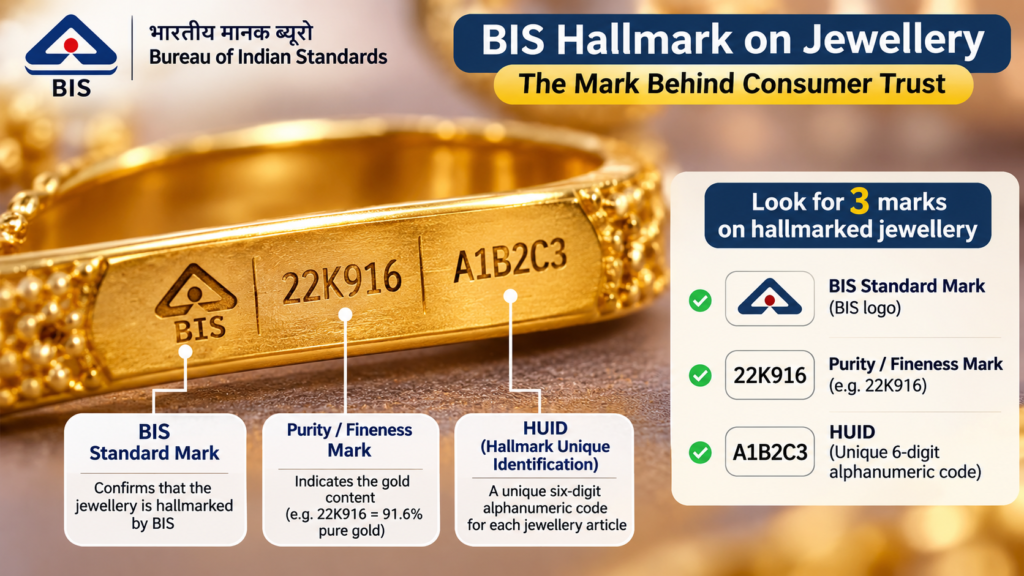
A central feature of the hallmarking framework is the six-digit alphanumeric HUID code assigned to each hallmarked jewellery article. It enables individual identification and traceability, linking the article to its purity, product type, jeweller and assaying centre.
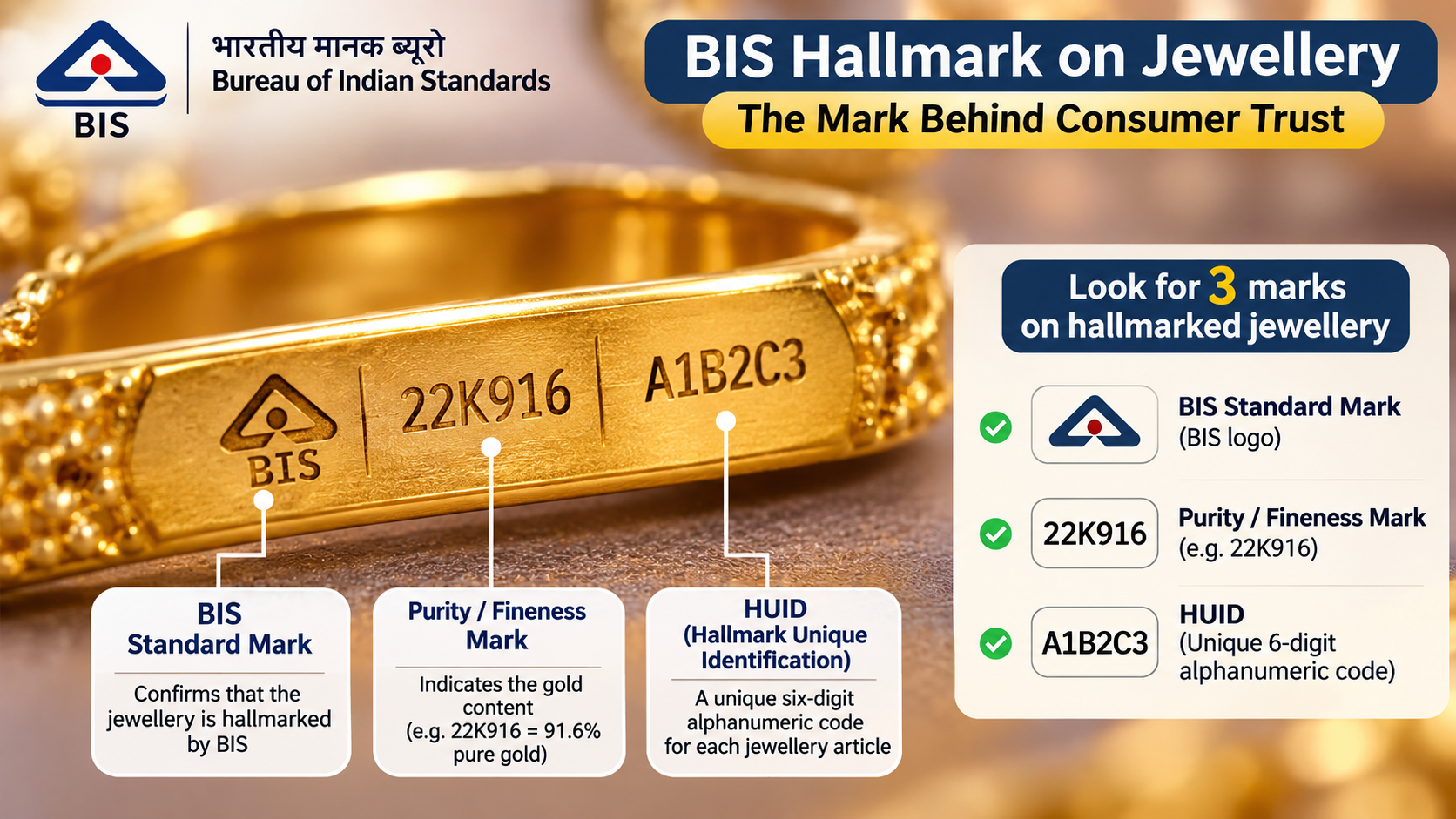
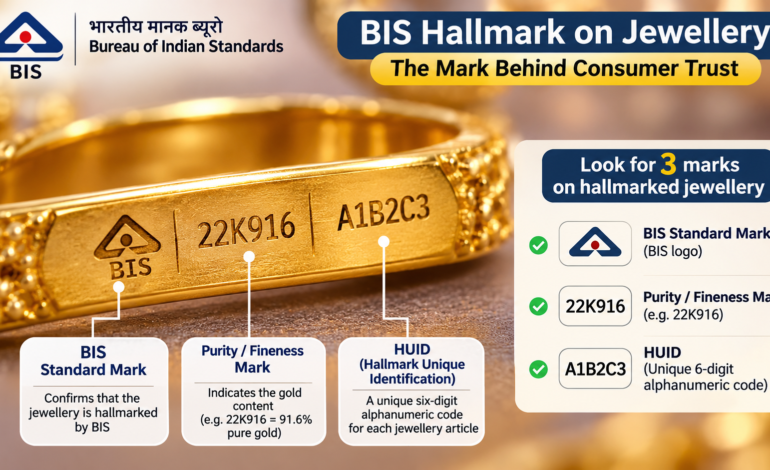
Consumers purchasing gold jewellery are advised to check three identifying marks:
- BIS Standard Mark: Displays the BIS logo.
- Purity or fineness mark: Indicates the gold content, such as 22K916.
- HUID: The unique six-digit alphanumeric identification code.
Hallmarked silver articles carry the BIS Standard Mark with the word ‘SILVER’, the applicable purity mark and the HUID.
The digital identification system is supported by the BIS CARE mobile application, which allows consumers to verify jewellery by entering its HUID number.
The app provides details of the article’s purity, product type, jeweller and Assaying and Hallmarking Centre. Digital upgrades introduced on June 8, 2026, have further enabled consumers to access photographs of the jewellery article and its hallmark, along with its automatically recorded weight.
This allows buyers to compare the physical article with the information available in official records before completing a purchase. The BIS CARE App is available free of charge on Android and iOS and supports 12 languages.
Digital integration strengthens hallmarking traceability
BIS has progressively integrated digital systems and testing equipment into the hallmarking process to improve accuracy and reduce the scope for manual intervention.
The process begins with the registration of jewellers and the recognition of Assaying and Hallmarking Centres. Registered jewellers can submit hallmarking requests through the Manak Online portal, providing details such as jewellery category, quantity, weight and declared purity.
At the AHC, the jewellery is tested using prescribed equipment, including weighing balances and X-ray fluorescence (XRF) machines. Following testing, the BIS server generates a unique HUID for each article, which is marked along with the BIS Standard Mark and purity mark.
API-based integration of XRF machines was implemented from September 1, 2024, enabling direct data transfer and eliminating manual data entry. Integrated weighment systems similarly capture readings directly from weighing balances.
Since June 8, 2026, AHCs have also been required to upload photographs of jewellery articles, their hallmarks and recorded weights directly to the Manak Online portal.
Digital timestamps recording activities at AHCs help BIS monitor operations, track the time taken between receipt and dispatch of jewellery, and examine whether purity testing was completed before laser marking.
Another facility, Transfer HUID, enables jewellers to digitally transfer HUID information through the BIS platform when gold jewellery changes hands between jewellers or outlets. Its first phase, implemented on June 1, 2026, covers transfers between corporate jewellers and transfers from any jeweller to a corporate entity, helping prevent duplicate or fraudulent hallmarking.
Regulatory surveillance backs digital monitoring
Digital traceability is complemented by physical inspections, sample testing and regulatory enforcement.
BIS periodically visits jewellery sales outlets and randomly selects hallmarked articles for testing against applicable Indian Standards. It also conducts surveillance audits of Assaying and Hallmarking Centres to verify their continued compliance with prescribed requirements.
The Bureau undertakes enforcement action, including raids, based on complaints or information concerning the misuse of hallmarks. More than 30 enforcement activities against jewellers for such violations were conducted during 2025–26.
These measures are intended to strengthen accountability across the hallmarking chain, from purity testing and identification to the sale of jewellery.
Consumer awareness remains a priority
Alongside infrastructure expansion and digital upgrades, BIS has continued to conduct consumer awareness programmes to familiarise buyers with hallmarking standards and verification procedures.
Between April 1 and October 31, 2026, BIS Regional and Branch Offices organised 1,582 consumer awareness programmes across the country. These included programmes on standards under compulsory certification, hallmarking and sensitisation initiatives at Gram Panchayat level.
The expansion of HUID-based hallmarking, digital verification facilities and regulatory oversight reflects the growing role of technology in consumer protection. By enabling buyers to independently verify jewellery details and strengthening traceability across the supply chain, the BIS framework seeks to make purity assurance an integral part of India’s gold and silver jewellery market.