Policy Rhetoric, Structural Void: India’s ESG Push Missing Legal and Institutional Spine
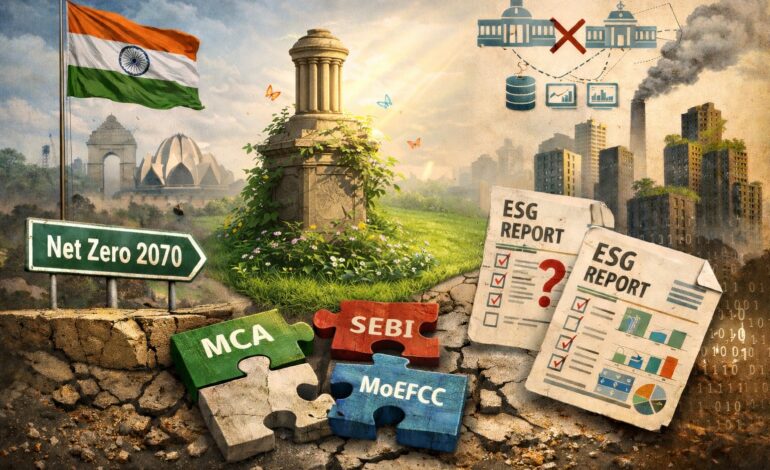
While the government points to indirect references - CSR provisions (Section 135), directors’ duties (Section 166), and board reporting (Section 134) - these are fragmented proxies, not a cohesive ESG framework.

No legal definition, no coordination mechanism, no unified data backbone – RTI disclosures expose structural gaps that could undermine India’s Net Zero 2070 ambitions
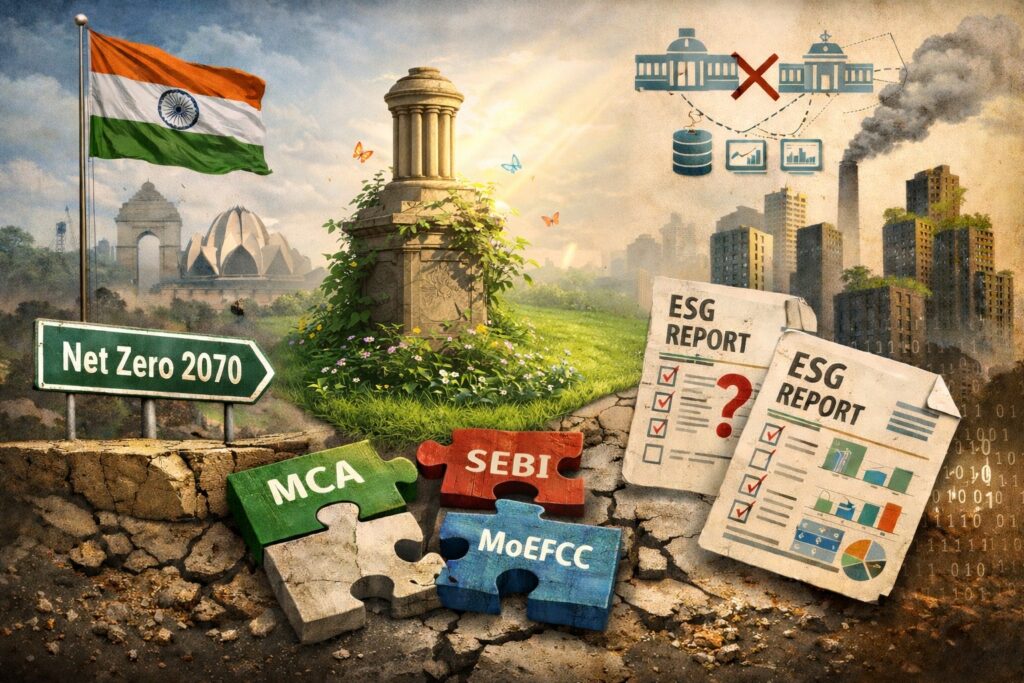
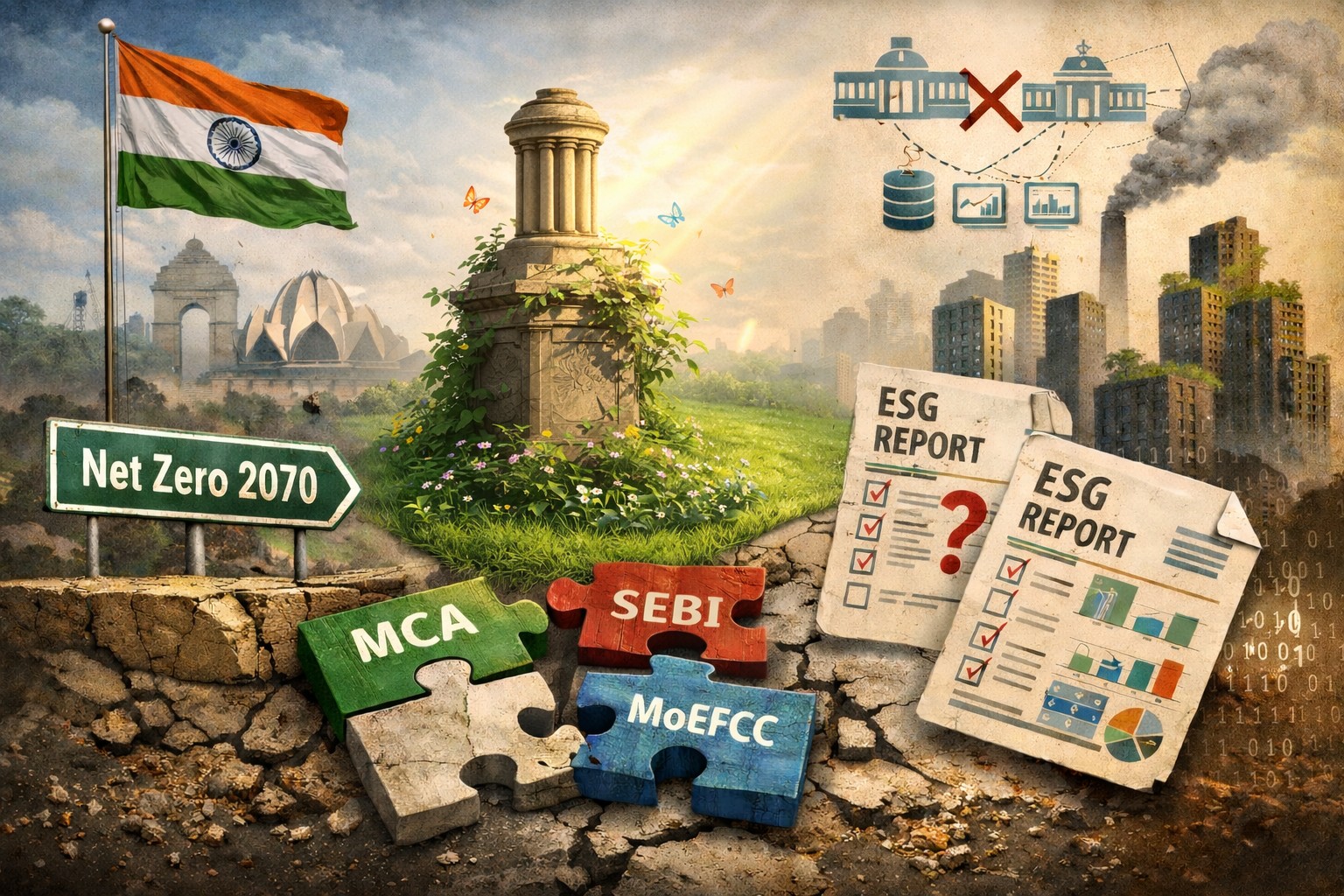
New Delhi: India has positioned itself as a global climate leader, committing to Net Zero by 2070 at COP26. At the same time, regulators like Securities and Exchange Board of India have introduced frameworks such as Business Responsibility and Sustainability Reporting (BRSR), signalling a shift towards ESG-led governance.
However, a recent RTI response from the Ministry of Corporate Affairs reveals a stark disconnect between policy ambition and institutional preparedness.
No Legal Definition, No Policy Backbone
The RTI makes it unambiguous:
ESG is not defined under the Companies Act, 2013.
While the government points to indirect references – CSR provisions (Section 135), directors’ duties (Section 166), and board reporting (Section 134) – these are fragmented proxies, not a cohesive ESG framework.
This raises a fundamental concern:
Can ESG be enforced meaningfully without legal recognition?
In its current form, ESG in India remains:
- Interpretative rather than prescriptive
- Voluntary in spirit, compliance-driven in pockets
- Largely dependent on regulator-specific initiatives
Fragmented Governance: Ministries Working in Silos
The most critical revelation is the absence of inter-ministerial coordination.
There is no formal mechanism for ESG-related data sharing between:
- Ministry of Corporate Affairs
- Securities and Exchange Board of India
- Ministry of Environment, Forest and Climate Change
This institutional fragmentation has deep implications:
1. Data Silos
Companies report ESG data under multiple frameworks:
- BRSR (SEBI)
- Environmental clearances (MoEFCC)
- CSR disclosures (MCA)
Yet, there is:
- No unified ESG data architecture
- No interoperability
- No single source of truth
2. Regulatory Overlaps and Gaps
Different regulators operate with:
- Divergent definitions
- Non-aligned metrics
- Varying enforcement standards
This leads to compliance duplication for companies and policy blind spots for the government.
3. Weak Accountability Mechanisms
Without coordination:
- ESG disclosures risk becoming box-ticking exercises
- Cross-verification of environmental and social claims becomes difficult
- Greenwashing risks increase
Limited Policy Evolution Since 2020
The RTI points to just one formal policy document:
Report of the Committee on Business Responsibility Reporting (2020)
This is significant because:
- It predates BRSR implementation
- It reflects an advisory stage, not a mature regulatory ecosystem
Since then, ESG evolution has largely been driven by:
- SEBI (through BRSR mandates)
- Market expectations (investors, global supply chains)
not by a whole-of-government strategy.
Net Zero 2070: Ambition Without Architecture?
India’s Net Zero commitment demands:
- Decarbonisation across sectors
- Massive capital mobilization
- Transparent ESG metrics
Yet, the RTI suggests:
- No centralized ESG governance framework
- No integrated monitoring system
- No inter-ministerial data backbone
This creates a structural paradox:
India is committing globally, but coordinating weakly domestically.
Is ESG Institutionally Embedded in India?
Short answer: Not yet.
India’s ESG ecosystem today is:
Partially Embedded
- Through SEBI’s BRSR framework
- Through CSR mandates under Companies Act
- Through environmental regulations by MoEFCC
But Systemically Fragmented
- No legal definition of ESG
- No unified regulatory authority
- No inter-ministerial coordination mechanism
- No integrated ESG data infrastructure
Read the article on ESG Bureau
The Way Forward: From Fragmentation to Framework
To move from intent to impact, India needs:
1. Legal Recognition of ESG
A formal definition under the Companies Act or a dedicated ESG legislation.
2. National ESG Coordination Authority
A cross-ministerial body integrating:
- MCA
- SEBI
- MoEFCC
- Ministry of Finance
3. Unified ESG Data Grid
A digital backbone (potentially aligned with India Stack) to:
- Aggregate disclosures
- Enable real-time monitoring
- Reduce compliance duplication
4. Alignment with Net Zero Strategy
ESG metrics must be directly linked to:
- Sectoral decarbonisation pathways
- Climate finance frameworks
Conclusion: A Defining Policy Moment
India stands at a critical juncture.
The ESG narrative is gaining momentum in boardrooms and global markets—but the RTI response underscores a hard truth:
ESG in India is still regulator-led, not system-led.
If India is to translate its Net Zero 2070 vision into measurable outcomes, ESG must evolve from a collection of guidelines into a cohesive institutional framework.
Until then, ESG will remain aspirational in policy, but uneven in practice.