India Calls for Global Unity on Big Cat Conservation at CoP30; To Host Global Big Cats Summit in New Delhi in 2026
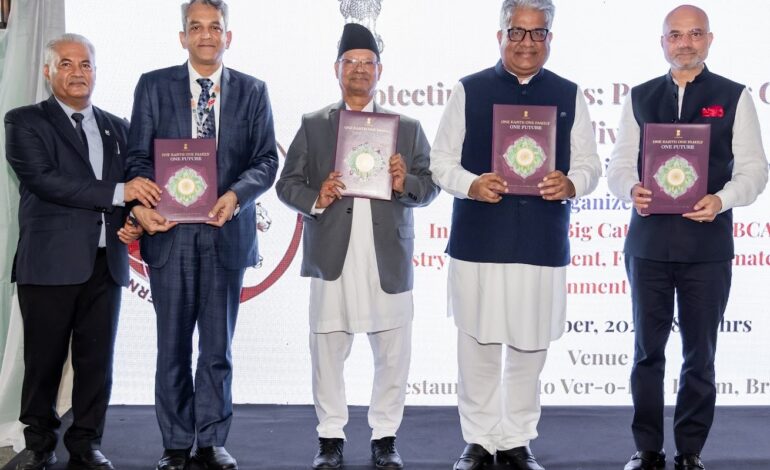
Union Minister for Environment, Forest and Climate Change, Bhupender Yadav, at the High-Level Ministerial Segment on the International Big Cat Alliance (IBCA) at UNFCCC CoP30 in Belém, Brazil, on Monday.

Environment minister links big cat protection with climate action, ecosystem resilience at UNFCCC meet in Brazil
Belém (Brazil), November 18: India reinforced its leadership in big cat conservation at the High-Level Ministerial Segment on the International Big Cat Alliance (IBCA) during CoP30 on Monday, with environment minister Bhupender Yadav calling for deeper global cooperation to protect big cat species and their habitats amid rising climate pressures.
Addressing delegates, Yadav said ecological challenges today are interconnected, and conserving apex predators such as tigers, lions, leopards and snow leopards is central to climate resilience. He described big cats as regulators of ecological balance and “sentinels of ecosystem health,” adding that landscapes where big cats thrive show stronger carbon storage, healthier forests, functioning water systems and regenerated grasslands.
He warned that declines in big cat populations destabilize ecosystems, weaken climate resilience and erode natural carbon sinks.
The minister positioned “big cat landscapes” as nature-based climate solutions, urging countries to place nature-led conservation at the core of future Nationally Determined Contributions. “What we call wildlife conservation is climate action in its most natural form,” he said, noting that protecting big cat habitats enhances carbon sequestration, watershed protection, disaster risk reduction, climate adaptation and sustainable livelihoods.
Yadav highlighted IBCA’s role in providing technical assistance, capacity building, standardized tools, south–south cooperation and access to blended finance and biodiversity-carbon credit mechanisms.
India houses five of the world’s seven big cat species and has recorded significant successes, including doubling its tiger population ahead of schedule and consistent growth in the Asiatic lion population. The minister said India has developed one of the world’s most expansive wildlife databases through large-scale population assessments of tigers, lions, leopards and snow leopards, while expanding protected areas, securing ecological corridors and working with local communities on conservation-linked livelihoods.
IBCA, conceptualized by Prime Minister Narendra Modi, now has 17 formal member countries, with more than 30 expressing interest in joining. Yadav said India aims to bring all big cat range nations and biodiversity-focused countries under the alliance, founded on the principle of “One Earth, One World, One Future.”
Against this backdrop, he announced that India will host the Global Big Cats Summit in New Delhi in 2026. He invited all range countries to participate and share strategies for protecting big cats and their habitats.
Calling for unity, Yadav said the world is at a moment of ecological realignment that demands collaboration over competition. “Protecting big cats is protecting our shared planet. Protecting big cats is protecting our future,” he said.