AI Must Be Aligned with Public Interest, Equity to Shape Global Transformation
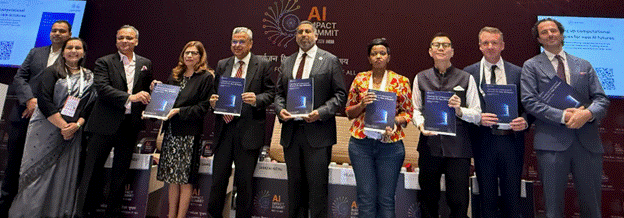
Leaders and experts release the working report Opening Up Computational Resources for New AI Futures during the India AI Impact Summit 2026 in New Delhi on Friday.

NEW DELHI: AI resources must be directed towards clearly defined public-interest outcomes, experts said at the India AI Impact Summit 2026, calling for equity, inclusion and mission-driven governance to anchor the next phase of global AI transformation.
The session, Building Public Interest AI: Catalytic Funding for Equitable Access to Compute Resources, also marked the launch of the working report Opening Up Computational Resources for New AI Futures by Dr. Saurabh Garg, Secretary, Ministry of Statistics and Programme Implementation.
The discussion brought together government leaders, philanthropic institutions and global AI experts to examine how catalytic funding, new institutional models and South–South cooperation can make advanced compute accessible and affordable for the Global South.
Speakers underlined that the focus must shift from merely expanding data centre capacity to ensuring that computational resources translate into measurable public outcomes across sectors such as health, education and agriculture. Demand aggregation, shared infrastructure, skills development and mission-driven governance were identified as critical to bridging the gap between access and deployment for startups, researchers and social-sector organisations.
Dr. Saurabh Garg, Secretary, Ministry of Statistics and Programme Implementation, placed equity at the centre of the global AI transition. Saurabh Garg said the defining question before policymakers is whether AI-driven transformation will be equitable, inclusive and aligned with public interest, adding that this issue sits at the core of the current global conversation.
Martin Tisné, CEO, AI Collaborative, warned of a potential disconnect between infrastructure creation and real utilisation. Martin Tisné said there is a risk that countries, including those in the Global South, may build computing capacity without ensuring effective use, leading to underutilised data centres despite expanded infrastructure.
Vilas Dhar, President, Patrick J. McGovern Foundation, stressed that transforming AI into a scalable service for consumers and creators is fundamentally a policy challenge. Vilas Dhar said progress cannot rely solely on private markets or expect frontline nonprofits to become developers, and called for building institutions that can connect policy, capital and deployment at scale over the next year.
Shikoh Gitau, CEO, Qhala, emphasised that compute demand must be anchored in clearly defined development outcomes. Shikoh Gitau said GPUs must be deployed in service of solving real problems in health, education and agriculture, noting that clear use cases would also clarify governance frameworks and cross-country cooperation.
Shaun Seow, CEO, Philanthropy Asia Foundation, highlighted demand aggregation, concessional access models and skills development as key enablers of broader access to advanced computing. Shaun Seow said emerging cloud models and GPU-as-a-service platforms could unlock AI for social impact and economic value, but pointed to Asia’s significant skills gap as a major constraint on fully leveraging this potential.
The session outlined a roadmap combining catalytic public and philanthropic capital, shared compute infrastructure and interoperable governance frameworks to position AI as a global public good.