TRAI sets IP interconnection port charge ceilings; new rules to take effect from January 2027
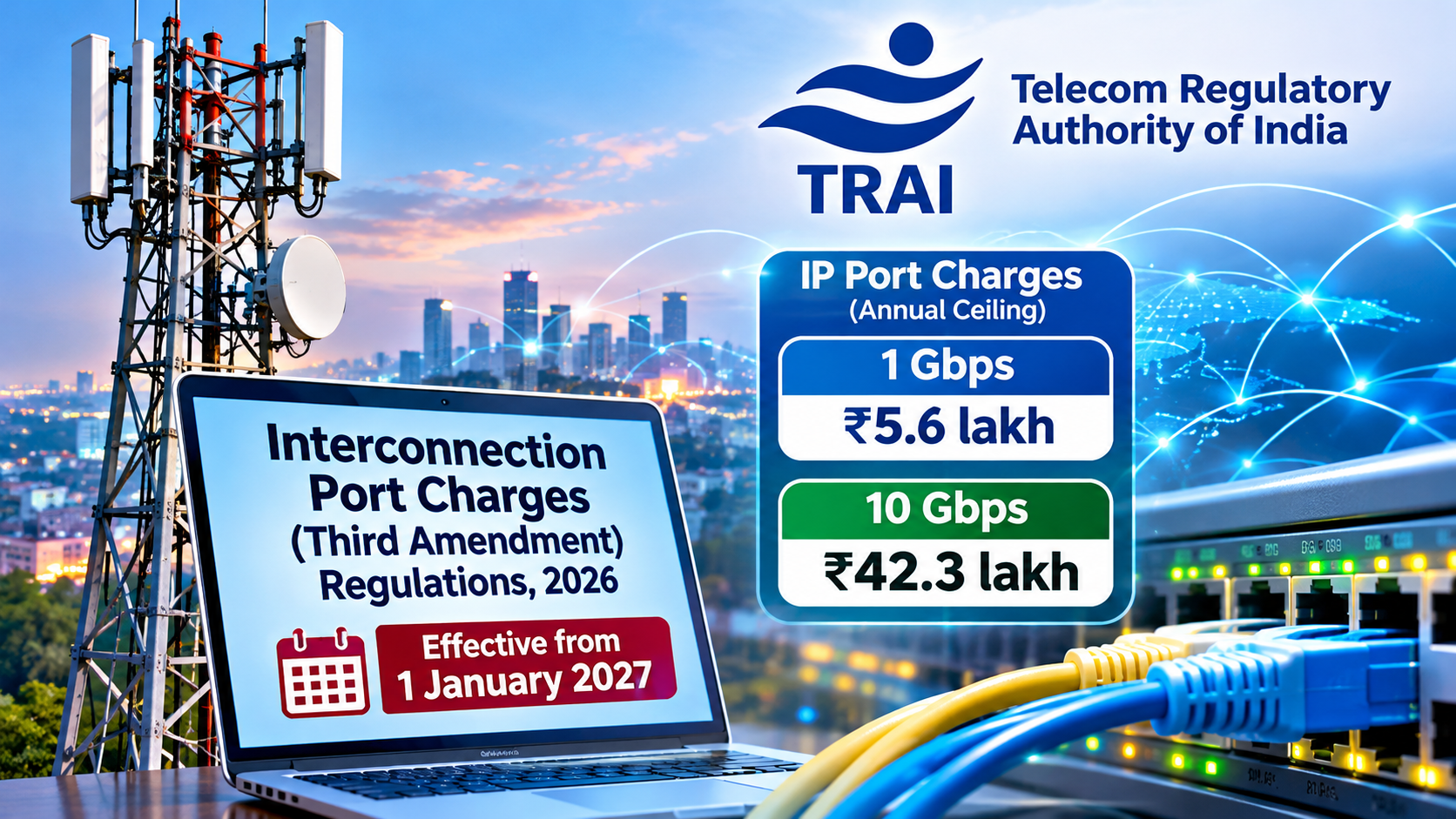
The revised framework caps annual charges at ₹5.6 lakh for a 1 Gbps IP port and ₹42.3 lakh for a 10 Gbps port, aligning telecom interconnection regulations with evolving network
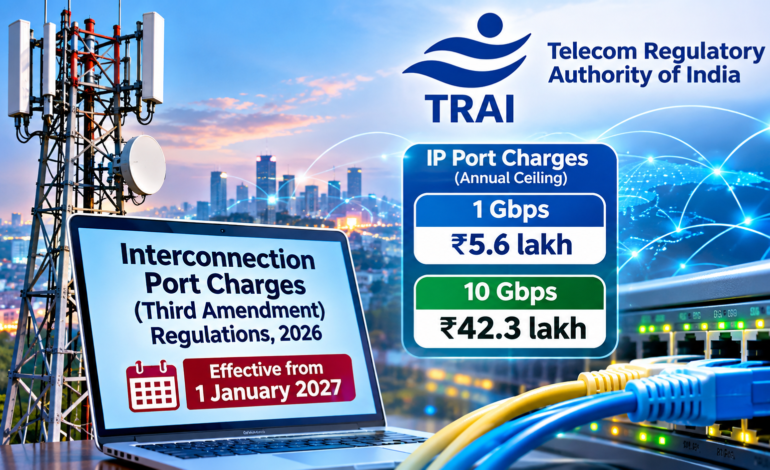
Under the revised framework, the annual ceiling charge for a 1 Gbps IP port has been fixed at ₹5.6 lakh, while a 10 Gbps IP port will carry a ceiling of ₹42.3 lakh.

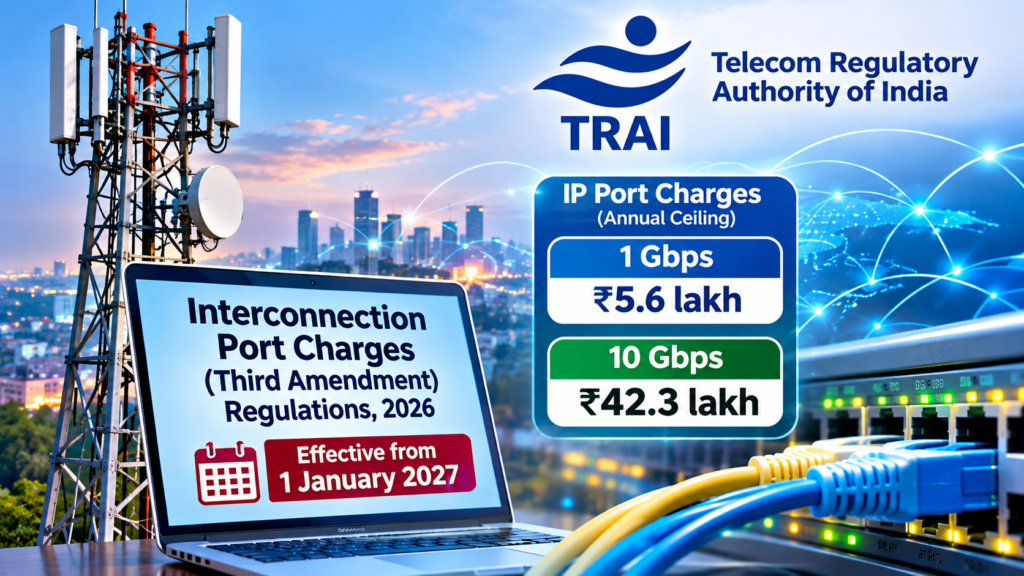
NEW DELHI: The Telecom Regulatory Authority of India (TRAI) has introduced a revised framework for port charges on IP-based telecom interconnections, setting annual ceiling rates for 1 Gbps and 10 Gbps ports. The new regulations will come into effect from January 1, 2027.
The changes have been notified through the Telecommunication Interconnection (Port Charges) (Third Amendment) Regulations, 2026, extending the existing regulatory framework, which primarily covered legacy E1/TDM-based interconnection ports, to include IP-based network infrastructure.
Under the revised framework, the annual ceiling charge for a 1 Gbps IP port has been fixed at ₹5.6 lakh, while a 10 Gbps IP port will carry a ceiling of ₹42.3 lakh.
The amendment is intended to provide greater regulatory clarity and transparency in the commercial arrangements between telecom service providers, while supporting efficient interconnection across networks.
IP-based interconnection brought under regulatory framework
Telecom interconnection refers to the technical, operational and commercial arrangements through which two or more networks are connected, enabling users of different service providers to communicate seamlessly.
The existing Telecommunication Interconnection (Port Charges) Regulation, 2001 prescribed charges payable by an interconnection seeker to an interconnection provider for terminating interconnection links at a point of interconnection.
The earlier framework was based on E1/TDM technology, with prescribed charges last revised in 2012.
With the transition towards IP-based networks and higher-capacity interconnection infrastructure, TRAI has now expanded the definition of a port to cover both legacy E1 ports, operating at 2.048 Mbps, and IP ports, with bandwidth expressed in Mbps or Gbps.
Service providers can negotiate lower charges
The revised regulations allow interconnection providers and seekers to mutually agree on charges below the prescribed ceiling rates.
They can also agree on IP-port capacities other than the specified 1 Gbps and 10 Gbps configurations. In such cases, charges must be determined transparently using the same methodology prescribed for the standard capacities.
The IP-port charges will apply uniformly across fixed-line, mobile, national long-distance and international long-distance services.
The existing charges will continue to apply to E1-based ports, while the new ceiling-based framework will govern IP ports.
Financial disincentives for regulatory violations
The amendment also introduces a graded framework of financial disincentives to strengthen compliance.
A maximum financial disincentive of ₹15 lakh per Service Area for each instance of contravention has been prescribed for violations of specified provisions of the regulations.
The measure is intended to reinforce adherence to the revised interconnection framework and ensure transparency and non-discriminatory treatment among service providers.
Consultation process preceded regulatory changes
TRAI initiated the review of its interconnection regulations through a pre-consultation paper issued on April 3, 2025, seeking stakeholder views on the existing framework, including port charges.
A subsequent consultation paper was issued on November 10, 2025. Seventeen stakeholders submitted comments and nine submitted counter-comments. An Open House Discussion was held on January 28, 2026, as part of the consultation process.
Based on the submissions and its own assessment, TRAI finalised the third amendment to the port charges regulations.
Greater certainty for telecom operators
The revised framework aligns interconnection charges with the shift towards IP-based telecom infrastructure and higher-capacity networks.
By establishing ceiling rates while allowing mutually agreed lower charges and flexible port capacities, the regulations seek to balance commercial flexibility with regulatory oversight.
The changes are expected to provide greater certainty to telecom operators, promote transparency in network interconnection arrangements and support seamless communication across India’s telecom networks.
The full regulations and accompanying explanatory memorandum are available on the TRAI website at www.trai.gov.in.