India builds semiconductor-to-AI stack as chip manufacturing and indigenous models gain momentum
India is building an integrated semiconductor-to-AI ecosystem, with ₹1.64 lakh crore in chip projects, 45,000+ GPUs, indigenous AI models and expanding data-centre capacity driving its technology ambitions.
Under the Chips to Startup programme, electronic design automation tools have been deployed in 320 academic institutions, while more than 68,000 students have been trained.

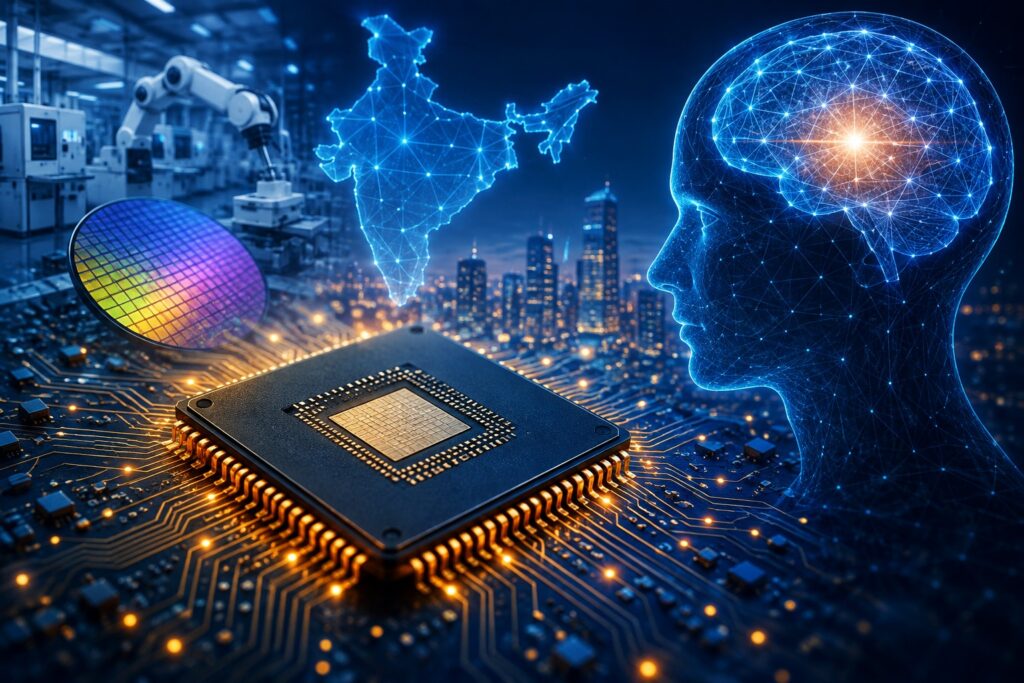
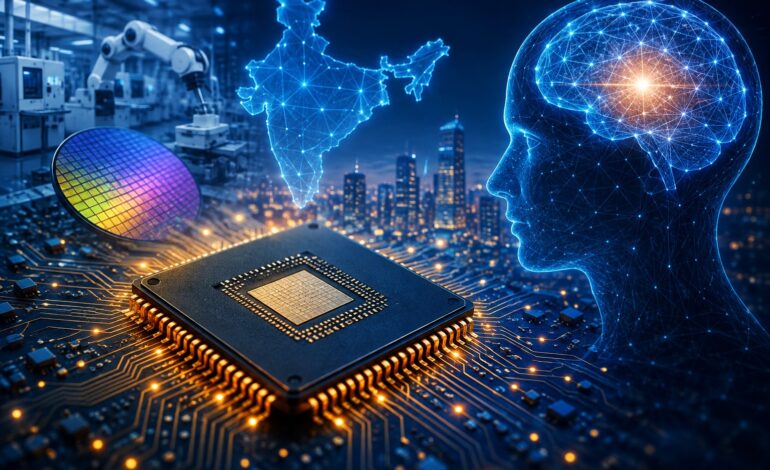
NEW DELHI: India is building an integrated technology ecosystem spanning semiconductor manufacturing, chip design, high-performance computing and indigenous artificial intelligence models, marking a shift from technology policy and research towards production and commercial deployment.
A new government backgrounder on the semiconductor and AI sectors highlights the growing convergence between the two technologies, with advanced AI driving demand for specialised chips and computing infrastructure while semiconductor capabilities provide the foundation for India’s broader technology ambitions.
The semiconductor programme has entered a new phase with 12 projects approved across six states, involving investment commitments of more than ₹1.64 lakh crore. The projects cover silicon and compound semiconductor fabs, display fabrication and advanced packaging, while three facilities have already commenced commercial production.
The government has also approved Semicon 2.0 with an outlay of ₹1,27,500 crore, expanding the focus beyond fabrication to chip design, semiconductor equipment and materials, advanced packaging, research and development and talent development. The programme builds on the ₹76,000-crore Semicon 1.0 initiative.
Chip design ecosystem expands
India is simultaneously building domestic semiconductor design capabilities.
Under the Chips to Startup programme, electronic design automation tools have been deployed in 320 academic institutions, while more than 68,000 students have been trained. Twenty-four semiconductor design projects have also received financial support, while 105 startups and MSMEs have received support for EDA tools under the Design Linked Incentive scheme.
By April 2026, 211 chips had been taped out by 75 institutions, while seven chips had been successfully fabricated at various nodes, including advanced nodes such as 12 nm. The government says Semicon 2.0 will further support semiconductor intellectual property, chip and system designs to strengthen India’s position as a global semiconductor design hub.
IndiaAI scales computing capacity
The semiconductor push is being matched by expansion of India’s AI infrastructure.
The IndiaAI Mission, approved with an outlay of about ₹10,372 crore, has expanded shared computing capacity to more than 45,000 GPUs as of June 2026.
By August, 237 projects had accessed subsidised AI computing, accounting for 93.18 lakh GPU hours. The government says this is intended to lower the cost barrier for Indian researchers, startups and innovators developing, training and testing AI models.
India is also building its own foundation-model ecosystem. From 506 applications received under the initiative, the government has selected 20 indigenous foundation-model proposals, comprising 12 Large Multimodal Models and eight Small Language Models.
At the data layer, AI Kosh hosts more than 14,000 datasets and 331 AI models, providing resources for researchers, developers and innovators building AI applications. IndiaAI initiatives have also developed 62 AI prototypes and deployed 20 AI solutions across public-sector institutions as of August 2026.
From AI research to public applications
The government has approved 58 Artificial Intelligence Centres of Excellence across States and Union Territories, with 22 already approved and initiated across 13 States and UTs.
The centres are intended to strengthen domain-specific research, innovation and application development. At the same time, 11 national-level hackathons and innovation challenges are expanding the pipeline from AI ideas to deployable solutions.
The government is also placing emphasis on responsible AI. Thirteen projects had been approved under the Safe & Trusted AI pillar of the IndiaAI Mission by July 2026, addressing issues including bias mitigation, machine unlearning, deepfake detection, privacy-preserving AI, explainability and AI risk assessment.
Data centres provide the physical backbone
The expansion of AI is driving demand for data-centre infrastructure. India’s installed data centre capacity has increased from 375 MW in 2020 to about 1,575 MW, with facilities located in major technology and business centres, including Mumbai, Navi Mumbai, Chennai, Hyderabad, Bengaluru, Delhi NCR and Gujarat.
New investment destinations are also emerging in Andhra Pradesh, Madhya Pradesh, Chhattisgarh and West Bengal.
The backgrounder notes that India ranked third globally in AI competitiveness and ecosystem vibrancy in the Stanford Global AI Vibrancy Report 2025. It also says India was the second-largest contributor to GitHub AI projects in 2025, reflecting the strength of its developer and innovation ecosystem.
Taken together, the developments point to a broader strategy: building not just individual semiconductor or AI capabilities, but an integrated technology stack covering chips, computing, data, AI models, skills, research and commercial applications.
The semiconductor programme is moving towards commercial production, while the IndiaAI Mission is expanding computing infrastructure and supporting indigenous models and applications. The government says this convergence is intended to strengthen supply-chain resilience, domestic value addition, innovation and India’s long-term technology competitiveness.