New Aadhaar Card, No Personal Details: UIDAI Rolls Out Privacy-First Redesign; When Should You Switch?
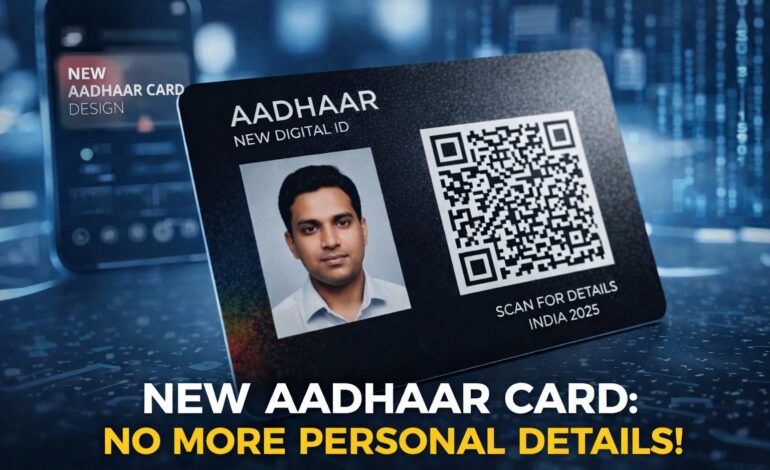
Under the redesigned format, the physical Aadhaar card now displays only two elements; no personal details—including name, Aadhaar number, address, date of birth or gender—will be printed on the card.

New Delhi, December 30: Just ahead of the start of 2026, the Unique Identification Authority of India (UIDAI) has announced a series of far-reaching changes to the Aadhaar ecosystem, aimed at strengthening digital security, protecting citizen privacy and curbing the misuse of identity data.
Several key provisions will come into force after midnight on December 31, 2025, marking one of the most significant upgrades to Aadhaar since its inception.
New Aadhaar card design from December 1
At the centre of the reform package is a new Aadhaar card design, rolled out from December 1, 2025, in response to rising incidents of data leaks, identity theft and digital fraud.
Under the redesigned format, the physical Aadhaar card will display only two elements:
- The cardholder’s photograph
- A secure, encrypted QR code
Notably, no personal details—including name, Aadhaar number, address, date of birth or gender—will be printed on the card.
UIDAI said the objective is to ensure that even if a photocopy of the Aadhaar card falls into the wrong hands, it cannot be misused.
QR code replaces visible personal data
All personal information will be embedded within the encrypted QR code, which will contain:
- Name
- Aadhaar number
- Date of birth
- Address
- Gender
- Biometric verification data (in encrypted form)
This information can be accessed only through UIDAI-authorised apps, government-approved scanners and certified verification devices. Hotels, event organisers, private offices or individuals will not be able to extract data through simple photocopies or unauthorised scans.
Existing Aadhaar cards remain valid
UIDAI clarified that existing Aadhaar cards will continue to remain fully valid, and immediate replacement is not mandatory. Citizens have been given time until June 14, 2026 to transition to the new card design.
Shift away from physical photocopies
As part of the overhaul, UIDAI is actively discouraging the practice of submitting physical photocopies of Aadhaar, which officials say account for a majority of Aadhaar-related data breaches.
Instead, UIDAI is prioritising secure digital verification methods, including:
- QR code–based verification
- Offline Aadhaar XML
- Masked Aadhaar
Moving identity checks to digital modes is expected to significantly reduce unauthorised data storage and misuse.
Face authentication gets legal backing
In another major change, face authentication has been granted formal legal recognition under the Digital Personal Data Protection (DPDP) law. Facial recognition will now be treated as a valid Aadhaar authentication method.
Officials said this will strengthen verification across banking, welfare schemes and public services, while reducing authentication failures in remote and underserved regions, where fingerprint or iris scans often prove unreliable. Experts believe the move will also help curb biometric fraud.
Final deadline for Aadhaar–PAN linking
UIDAI and tax authorities have reiterated that December 31, 2025 is the final deadline for linking Aadhaar with PAN. From January 1, 2026, PAN cards not linked with Aadhaar will become inoperative.
An inoperative PAN will disrupt:
- Income tax return filing
- Refund processing
- High-value financial transactions
Tax officials have warned that most tax-related activities will be blocked without an active PAN.
Mandatory updates for Aadhaar older than 10 years
UIDAI has also advised that Aadhaar cards issued more than 10 years ago should undergo periodic demographic updates to ensure uninterrupted functionality.
Updating details such as name, address and date of birth will help avoid authentication issues and service disruptions across banking, welfare and digital platforms.
What citizens should do now
Experts are urging citizens to act well before the deadlines to avoid last-minute complications. Recommended steps include:
- Completing Aadhaar–PAN linking before December 31, 2025
- Using digital or masked Aadhaar for verification wherever possible
- Avoiding unnecessary sharing of physical photocopies
- Updating Aadhaar details if the card is over a decade old
With these measures, UIDAI aims to transform Aadhaar into a privacy-first, digitally secure and globally benchmarked identity system, aligned with India’s broader Digital India and data protection goals as the country enters 2026.