India Records 357.73 MT Foodgrain Output, Strengthens Global Agri Leadership
Horticulture has emerged as a key driver of transformation, with total output reaching 362.08 million tonnes, reflecting a structural shift towards high-value crops.

Rising exports, policy push, and tech-driven reforms power resilient farm-to-market ecosystem
New Delhi: India’s agricultural sector has demonstrated strong resilience and sustained growth, achieving a record foodgrain production of 357.73 million metric tonnes in 2024–25, alongside a significant rise in exports and value-added output, according to a government report on resilient agricultural production systems.
The report highlights that agriculture continues to remain a critical pillar of the economy, contributing nearly one-fifth of gross value added and supporting around 46.1 percent of the workforce, while sustaining livelihoods for close to 55 percent of the population.
Horticulture has emerged as a key driver of transformation, with total output reaching 362.08 million tonnes, reflecting a structural shift towards high-value crops. This transition is also mirrored in export trends, with agricultural exports rising from USD 34.5 billion in FY20 to USD 51.1 billion in FY25, alongside a growing share of processed food in the export basket.
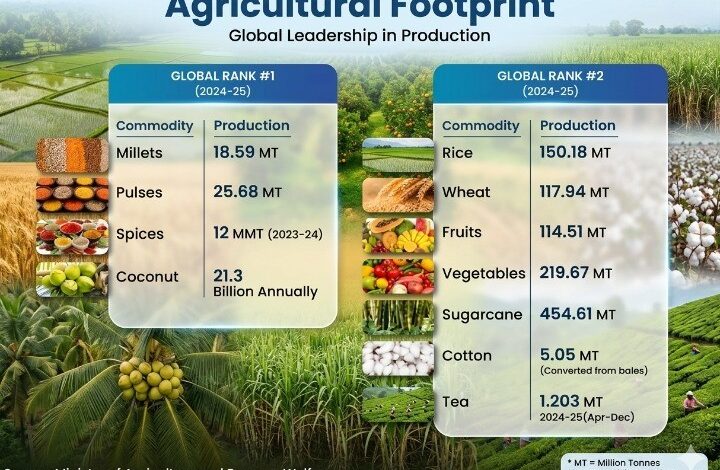
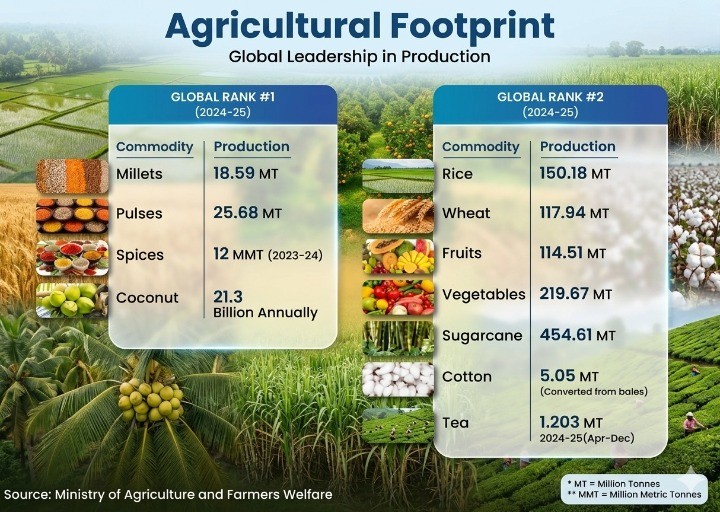
India continues to maintain a strong global position across commodities. The country ranks among the top producers of rice, wheat, pulses, and millets, reinforcing its role in global food security. It also leads in several high-value segments such as spices and coconut production, while maintaining a strong presence in fruits, vegetables, and cash crops like sugarcane and cotton.
The report attributes this performance to sustained policy support and increased public investment. Budget allocation for agriculture has risen sharply from ₹21,933 crore in 2013–14 to over ₹1.30 lakh crore in 2026–27, underlining the government’s long-term commitment to strengthening farm incomes and rural livelihoods.
Flagship initiatives such as PM-KISAN have disbursed over ₹4.27 lakh crore to farmers, while crop insurance claims exceeding ₹1.90 lakh crore have strengthened income security and risk protection. Simultaneously, technology-driven interventions—including soil health cards, irrigation expansion, and mechanisation support—are improving productivity and resource efficiency.
Digital platforms and market reforms are also reshaping the farm-to-market ecosystem. The e-National Agriculture Market (e-NAM) now connects over 1.8 crore farmers across more than 1,600 mandis, enhancing transparency and price discovery. Investments in storage, processing, and supply chain infrastructure are further strengthening agricultural value chains.
The report notes that sustainable agriculture practices are gaining traction, with natural farming expanding across 6.39 lakh hectares and over 15.79 lakh farmers adopting resource-efficient methods. These efforts, combined with mission-mode programmes in pulses, oilseeds, and nutrition, are driving a shift towards productivity-led and climate-resilient agriculture.
With continued focus on policy reforms, digital integration, and value addition, India’s agricultural sector is poised to play a pivotal role in ensuring food security, boosting exports, and supporting long-term economic stability.