From infectious diseases to personalised medicine, India enters futuristic healthcare phase: Jitendra Singh
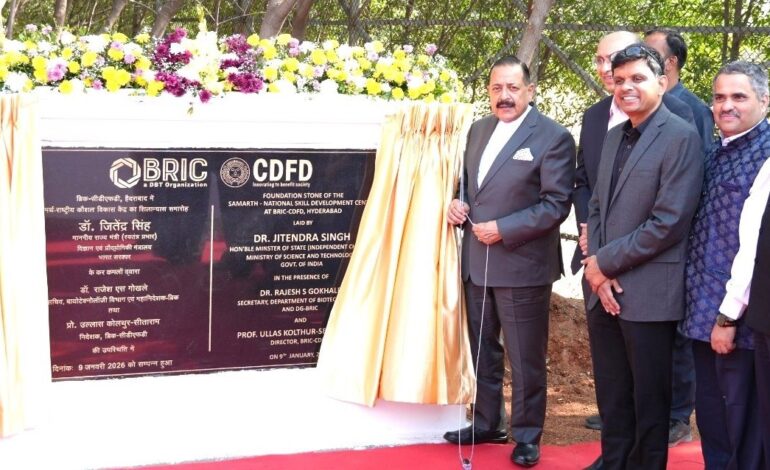
Foundation stone laid: Jitendra Singh unveils the plaque after laying the foundation stone of the SAMARTH National Skill Development Centre at the DBT-BRIC Centre for DNA Fingerprinting and Diagnostics (CDFD), Hyderabad, on Friday.

Hyderabad: India’s healthcare system is undergoing a decisive shift from battling infectious diseases to embracing molecular diagnostics, genome sequencing and personalised medicine, driven by advances in biotechnology and preventive healthcare, said Jitendra Singh during a visit to the DBT-BRIC Centre for DNA Fingerprinting and Diagnostics (CDFD).
Singh laid the foundation stone of the SAMARTH National Skill Development Centre and inaugurated the iDeA-NA BRIC-CDFD Technology Incubator at the Hyderabad-based institute. He said India is now scientifically and economically equipped to address complex health challenges, particularly genetic and rare diseases, but stressed that early detection and affordability remain the two biggest hurdles.
Institutions such as CDFD, he said, are critical in translating laboratory research into real-world clinical outcomes, enabling the healthcare system to move towards precision and personalised treatment. He noted that patients with similar conditions may increasingly require different therapeutic approaches, underscoring the importance of genomics-led healthcare.
Highlighting policy initiatives, Singh said biotechnology and health have received unprecedented priority under the current government, recalling the announcement of the Bio-E3 Policy from the Red Fort as a catalyst for innovation among scientists, startups and young researchers. He pointed to rapid progress in large-scale genome sequencing, paediatric genetic disease programmes and research in areas such as haemophilia.
On rare diseases, Singh said the National Policy for Rare Diseases introduced in 2021 marked a significant shift in the government’s approach, reflecting openness to scientific inputs. He added that diagnosis alone is insufficient unless long-term treatment is made affordable for affected families.
The minister also referred to the integrated healthcare model being promoted nationally, including the institutionalisation of traditional systems through the Ayush framework and the global recognition of yoga as a preventive health tool. Evidence-based integration of wellness practices with modern medicine, he said, has shown positive outcomes in managing lifestyle and metabolic disorders.
During his interaction with researchers, Singh reviewed ongoing projects at CDFD, including genome sequencing initiatives and public outreach programmes. He emphasised the need to communicate science in accessible language, particularly to engage the youth and build public trust in biotechnology.
Citing the expansion of India’s bio-economy, Singh said the number of biotech startups has grown sharply, alongside a rise in the sector’s economic contribution. He said the Biotechnology Research and Innovation Council has improved coordination among institutions, enabling high-impact research and stronger industry collaboration.
Singh also underlined India’s leadership in vaccines and preventive healthcare, noting that indigenous innovations are being deployed domestically and shared globally, strengthening the country’s role in global health security.
With nearly 70 per cent of the population below the age of 40, he said, investment in early diagnosis and prevention is a national priority, adding that institutions like CDFD are key to building a future-ready healthcare ecosystem.