





New Delhi: Reliance Jio has emerged as the top-performing telecom operator across key voice and data quality parameters in North Delhi and adjoining areas, according to an Independent Drive Test (IDT) conducted by the Telecom Regulatory Authority of India (TRAI) in April 2026.
The extensive assessment, carried out between April 13 and April 17, covered 449 kilometres across North Delhi, major public hotspots and the strategic IGI Airport–Noida Sector 121 corridor. The drive covered Jaunti, Kanjhawala, Bawana, Bakoli, Alipur, Rohini, Karala, Shastri Park, Burari, Shalimar Bagh, Mukherjee Nagar, Wazirabad, Ashok Nagar, Paschim Vihar, Janakpuri and the airport route connecting Delhi and Noida.
The regulator’s findings show that Jio led the industry in most key voice quality and mobile broadband performance indicators, reinforcing its dominance in Delhi’s highly competitive telecom market.
Jio Leads Voice Network Performance

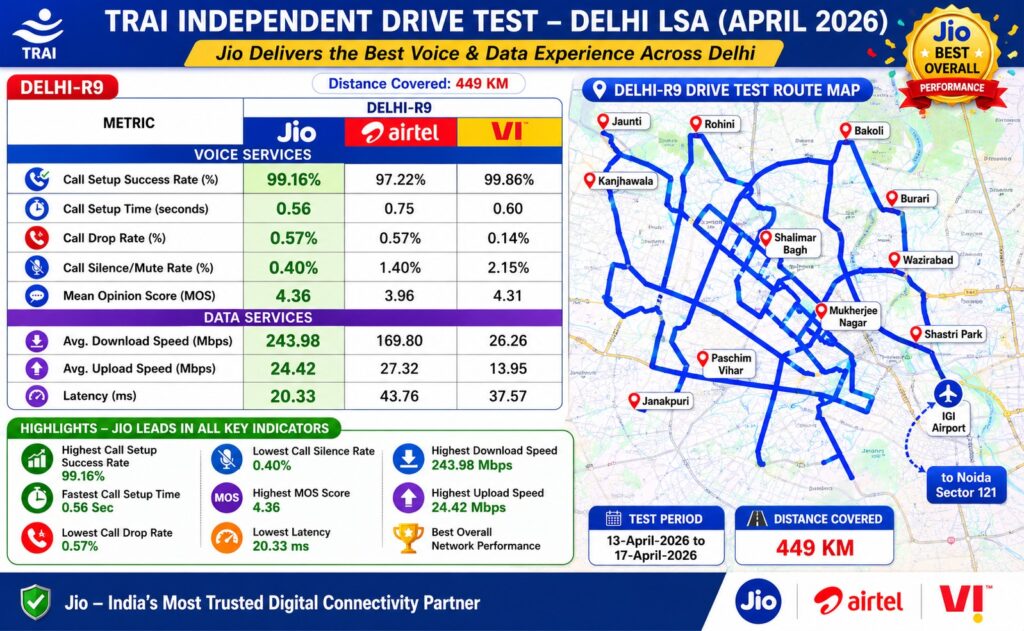
Among all telecom service providers evaluated, Reliance Jio Infocomm Ltd (RJIL) recorded the highest Call Setup Success Rate (CSSR) at 99.16%, comfortably exceeding regulatory benchmarks and outperforming competing operators. The company also registered the fastest average Call Setup Time of just 0.56 seconds, enabling subscribers to connect calls more quickly than users on rival networks.
Jio’s voice quality performance remained strong across other parameters as well.
The operator recorded a Call Drop Rate of 0.57%, comparable with leading operators and well within acceptable limits. More importantly, it delivered the lowest Call Silence Rate of 0.40%, indicating fewer interruptions and muted conversations during calls. The company also achieved the highest Mean Opinion Score (MOS) of 4.36 out of 5, reflecting superior voice clarity and overall user experience.
The report noted that Jio achieved a 100% handover success rate during testing, ensuring seamless call continuity when subscribers moved between network cells.
Fastest Mobile Broadband Experience
In data performance, Jio emerged as the clear leader in download speeds.
The operator recorded an average download throughput of 243.98 Mbps across the Delhi Licensed Service Area, significantly ahead of Airtel’s 169.80 Mbps, Vodafone Idea’s 26.26 Mbps and MTNL’s 4.43 Mbps.
Jio also led in upload performance among next-generation operators, registering average upload speeds of 24.42 Mbps, while delivering the lowest network latency of 20.33 milliseconds, an important factor for gaming, video conferencing, cloud applications and real-time digital services.
The operator’s 5G network presence was particularly strong throughout the drive route. TRAI observed that nearly 88% of Jio’s voice testing time and over 96% of its data testing time were spent on 5G networks, demonstrating the depth of its standalone 5G deployment across the surveyed region.
Coverage Across City, Hotspots and Airport Corridor
The drive test covered multiple categories including city routes, hotspot locations, walk tests and the airport corridor.
Hotspot testing was conducted at key public locations including Delhi Technological University, District Court Rohini, Fortis Hospital Shalimar Bagh, ISBT Kashmere Gate, Rohini West Metro Station, Samaypur Badli Metro Station and all three terminals of Indira Gandhi International Airport.
The airport route assessment between Noida Sector 121 and IGI Airport evaluated network performance along one of the National Capital Region’s busiest commuter corridors, increasingly important for business travellers, digital workers and app-based mobility services.
Industry-Wide Findings
The TRAI report found that private telecom operators significantly outperformed MTNL across most voice and data quality indicators.
While Airtel delivered strong upload speeds and Vodafone Idea achieved high call setup success rates in several segments, Jio consistently ranked among the top performers across voice quality, download throughput, latency and overall customer experience metrics.
The findings are part of TRAI’s ongoing nationwide Independent Drive Test programme, which evaluates the quality of mobile services delivered by telecom operators under real-world conditions. The results are intended to provide consumers with transparent information while encouraging service providers to improve network performance and customer experience.

