




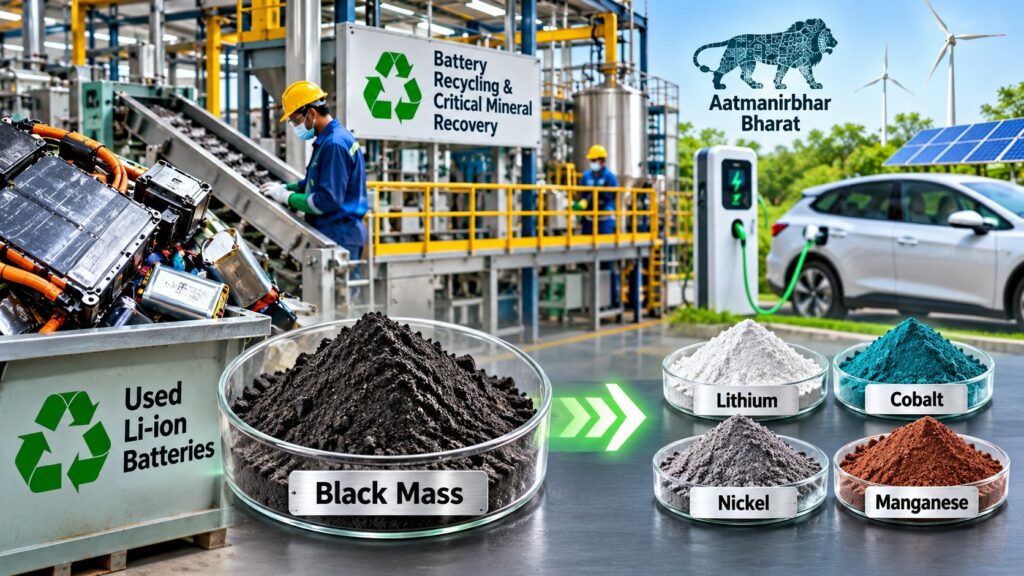
NEW DELHI: India has prohibited the export of lithium-ion battery black mass to strengthen domestic recycling capabilities and ensure the availability of critical minerals for its growing electric mobility, battery manufacturing and clean energy industries.
The Directorate General of Foreign Trade (DGFT), under the Department of Commerce, has amended the export policy for lithium-ion battery black mass under ITC(HS) Code 85491400 from ‘Free’ to ‘Prohibited’, with immediate effect and until further orders.
The decision was notified through Notification No. 49/2026-27 dated November 10, 2026.
Black mass is a powder-like material obtained from shredding end-of-life lithium-ion batteries and battery manufacturing waste. It contains recoverable quantities of critical minerals, including lithium, cobalt, nickel and manganese, which are essential for manufacturing batteries, electric vehicles, energy storage systems and electronic products.
Strengthening India’s critical mineral supply chain
The government said the restriction aims to ensure that valuable battery waste generated in India is processed domestically rather than exported for recycling and mineral recovery in other countries.
India depends substantially on imports for several critical minerals. Although domestic battery recycling and mineral refining capacities have expanded, their utilisation has been constrained by inadequate availability of raw materials.
The export of black mass has diverted valuable secondary resources overseas, while some domestic recycling facilities have had to import such materials to meet their operational requirements.
By retaining black mass within the country, the government expects to improve feedstock availability for domestic recycling and refining units, increase capacity utilisation and encourage further investments in the sector.
The measure is also expected to increase the domestic recovery of lithium, cobalt, nickel and other critical minerals, helping reduce import dependence and foreign exchange outgo.
Boost for electric mobility and battery manufacturing
The policy intervention is expected to strengthen supply chains supporting electric vehicles, advanced chemistry cell batteries, renewable energy storage and electronics manufacturing.
Critical minerals recovered from discarded batteries can be reused in manufacturing processes, reducing dependence on newly mined resources and supporting a more sustainable industrial ecosystem.
The government said the move would also promote the circular economy and urban mining, while encouraging environmentally responsible processing of hazardous battery waste in accordance with applicable regulations.
Complements ₹1,500 crore recycling incentive scheme
The export restriction complements the government’s ₹1,500 crore Incentive Scheme for Critical Mineral Recycling, approved by the Union Cabinet in September 2025.
The scheme aims to develop domestic recycling capacity for recovering critical minerals from secondary sources, including battery waste and electronic waste.
Ensuring adequate domestic availability of black mass is expected to help recycling facilities established under the scheme access the raw materials required for processing and mineral recovery.
The government said the decision is aligned with the National Critical Mineral Mission and the broader Aatmanirbhar Bharat vision of strengthening domestic supply chains for strategically important resources.
India’s move also reflects a growing international emphasis on retaining critical mineral-bearing battery waste for domestic processing, as countries seek greater control over resources essential for electric mobility, energy storage and advanced manufacturing.

