




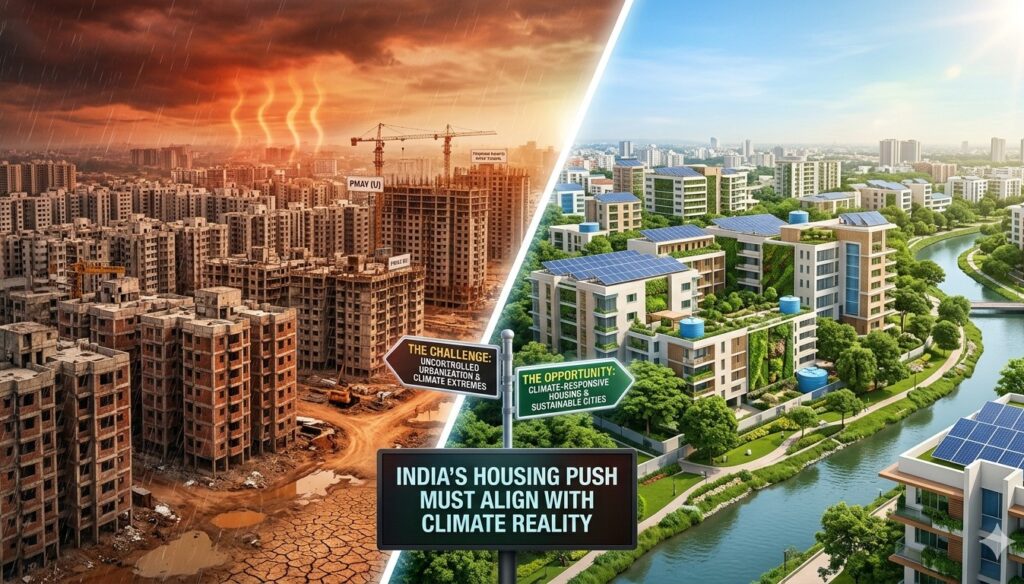
India’s development story is closely tied to its commitment to provide adequate housing for all. As India scales up housing at an unprecedented pace, a deeper question emerges. Are we designing homes for the climate we have, or the one we are entering? The answer will shape not just energy demand, but how India designs and builds its cities.
With a massive shortfall in adequate housing, particularly for the economically weaker sections, the scale of the shortage and the related construction required is unprecedented. The ambition to deliver nearly 30 million homes by 2029 under Pradhan Mantri Awas Yojana is not just a social mission but a once-in-a-generation opportunity to redefine how India builds.
India’s next phase of urbanisation is unfolding not just in large cities, but in smaller and intermediate towns, where planning capacity is limited, enforcement is weak, and climate-responsive design is least integrated.
And yet, for over two decades, the construction sector has been surrounded by an expanding vocabulary, modular & industrialized construction, energy efficiency, eco-friendliness, decarbonization, and green buildings. Conferences have multiplied, certifications have evolved, institutions have grown, and experts have earned recognition, but for most people, sustainability still feels like a distant buzzword.
Across the Global South, rising global temperatures are reshaping how buildings must be designed. India’s building ecosystem faces a similar paradox. Having the finest ingredients does not guarantee a good dish. What matters is how those ingredients are understood, combined, and translated into something that works in a real kitchen.
We have the knowledge, codes, guidelines, and technical frameworks, but we struggle to translate them into homes that work for everyday life. The challenges are being discussed in professional forums rather than implemented at scale. The core issue is not intent, but translation. India’s building ecosystem does not lack knowledge, but it struggles with application and governance design.
In many homes across India, summer is not just uncomfortable but exhausting. Tin roofs trap heat. Concrete slabs radiate it late into the night. Rooms remain hotter than the outside air. Sleep is disrupted, productivity drops, and daily life becomes a struggle. A house that cannot protect its occupants from heat is not just inefficient but is failing its most basic purpose.
And yet, much of the sustainability conversation continues to focus on energy savings rather than lived comfort. Reducing heat stress through better building design does more than improve comfort. It directly reduces the need for mechanical cooling, lowering energy demand and contributing to India’s long-term decarbonisation goals. India’s cooling demand is expected to grow rapidly in the coming decades, making passive cooling and climate-responsive design not just desirable, but essential for managing future energy use and emissions.
The solutions, however, are neither complex nor expensive. A simple cool roof, using reflective coatings or local materials, can reduce indoor temperatures by several degrees. Shaded windows, cross-ventilation, better building orientation, and climate-responsive materials can dramatically improve comfort. These are practical, proven strategies, often rooted in traditional knowledge.
But they are still missing from mainstream housing delivery, as we continue to pilot and discuss them in closed rooms rather than upscaling them. Affordable and climate-responsive housing has the potential to become the vehicle to mainstream sustainability across India’s cities and towns.
Part of the problem is pragmatic communication. Much like road signs that are clear to engineers but confusing to everyday users, sustainability remains inaccessible to the people it is meant to serve. As a result, sustainability has largely stayed confined to high-end and commercial developments, glass façades with ratings, campuses with plaques, and projects designed to signal compliance.
Meanwhile, the vast majority of India’s built environment, informal housing, small-town construction, and incremental self-built homes, remains untouched by this discourse. This gap is most visible in informal settlements, where high-density layouts, poor ventilation, and heat-trapping materials amplify extreme temperatures.
In these environments, heat is not just a seasonal challenge. It becomes a daily risk to health, livelihoods, and survival. This is where the real sustainability battle lies, not in iconic projects, but in ordinary homes.
Affordable, sustainable housing is, therefore, not just a social priority. It is the scale at which sustainability must be solved. If even a significant share of homes built under Pradhan Mantri Awas Yojana integrates basic principles of thermal comfort, passive cooling, and resource efficiency, sustainability will no longer remain aspirational. It will become systemic.
But this shift requires reframing the narrative itself. This shift is increasingly recognised in policy thinking, which emphasises moving beyond narrow energy metrics towards comfort, efficiency, and liveability. However, knowledge exists, but integration is missing. While these frameworks are well articulated in mission guidelines, their applicability at the grassroots level remains limited.
India already has a rich ecosystem of frameworks, from building codes to planning guidelines, that address many of these issues, but implementation remains inconsistent. Also, the challenge is that they operate in isolation from the systems that deliver housing. They are referenced but not embedded.
In India, the government is not just a regulator of housing, it is the largest producer of it. This fundamentally changes the equation. The question is no longer how to promote sustainable buildings as exceptions, but how to make them the default in public housing delivery.
As India moves towards higher-density, multi-storey housing, the risk is that we replicate inefficiencies at scale. The opportunity lies in doing the opposite, developing housing designs that respond to climate, cost, and context from the outset.
Efforts such as the Eco Niwas Samhita and ECSBC have laid important groundwork. But in most cases, codes are adopted “on paper” while their translation into actual building practice remains weak. When compliance becomes a checkbox for approvals, it loses its purpose. Because sustainability at scale is not about codes alone, it is about how housing gets built.
Equally important is how we think about housing itself. A home does not exist in isolation. It is part of a larger system of streets, open spaces, services, and infrastructure. When these are planned together, costs reduce, efficiency improves, and sustainability becomes easier to achieve. It is at this precinct scale that affordability and sustainability begin to reinforce each other.
India’s climate ambition is articulated at the national level, but it is implemented locally through Urban Local Bodies (ULBs). These institutions shape cities through approvals, planning regulations, and service delivery. In effect, they determine whether urban growth is sustainable or unsustainable.
And yet, their role in climate action remains underdefined. There are no clear building-sector targets at the city level, no explicit mandate for ULBs as climate delivery institutions, and no structured mechanism to translate national ambition into local action.
This gap is not about adding another guideline. It is about aligning systems through clearer mandates, stronger state–ULB partnerships, and performance-based incentives. Urban Local Bodies are expected to translate policy into practice, yet they lack the technical capacity, tools, and institutional support to do so.
Engineers, planners, and approval authorities need simple, actionable guidance, not just codes, to integrate climate-responsive design into everyday approvals. Without strengthening local capacity, even the best frameworks will remain underutilised.
This is where fiscal incentives can play a transformative role in delivering climate-responsive, livable housing. We should remember that what gets funded gets built. And what gets incentivised gets scaled.
To translate this intent to action, a simple three-part delivery framework can help align the system on the ground. First, there is a clear mandate to set measurable city-building performance targets, making ULBs accountable for outcomes. Second, a practical mechanism must embed these into everyday approvals through compliance tools. Thirdly, money must follow performance to demonstrate outcomes and not just construction.
Sustainability cannot be driven by regulation alone. It must also be shaped by demand. Unless people begin to ask for better-performing homes that are cooler and more liveable, the supply will remain limited.
When a household starts asking, “Will this house stay cool in summer?” instead of only “How much will it cost?”, the market will begin to respond. Real change will come when people expect more from the homes they live in.
But for most households, the choices remain unclear. What is the difference between cool roof paints, reflective tiles, and insulated panels? Which works best for a small house versus an apartment? Which is affordable, and which lasts longer?
This is where the sustainability discourse often falls short. It raises awareness but does not always provide clear answers. People do not need more terminology. They need guidance they can act on.
When solutions are simple, visible, and directly improve comfort, people are willing to adopt them. When demand becomes informed and widespread, the market will respond and, over time, correct inefficiencies and anomalies on its own.
This requires a shift from compliance-driven sustainability to comfort-driven performance. Sustainability must move from being expert-driven to ecosystem-driven.
Affordable housing offers the most powerful entry point for this shift. It forces a focus on cost, and in doing so, it drives practical, efficient, and accessible solutions.
If Pradhan Mantri Awas Yojana can evolve from a housing scheme into a platform for delivering climate-responsive, people-centric homes and if ULBs are empowered to lead this transformation, India can redefine how cities are built.
Because buildings do more than provide shelter, they shape how people live, work, and cope with a changing climate. India does not need new ideas in sustainable housing; what it needs is to make existing ones non-negotiable in every home built.
The article is authored by Dr Shailesh Kumar Agrawal, Former Executive Director of BMTPC under the Ministry of Housing and Urban Affairs, Govt. of India, and Hitesh Vaidya, Urban Practitioner (Former Director, National Institute of Urban Affairs, Govt. of India)


